
Wedding decorators in Goa, and why we are not one
Published 25 August 2026 · Updated 14 September 2026 · Rates from the venue book, Aug 2026
Most of the decor at Goa weddings is rented. The same mandap, the same backdrop and the same lounge set circulate through the same venues all season. A design-led build works the other way round: your wedding is drawn to scale first, then made for that site, once.
The short answer
The Goa Wedding Co. is a wedding planning and design studio in Panaji, Goa. It designs the decor for each wedding and has it built for the site rather than hired from a rental catalogue: mandaps, ceremony structures, haldi and sangeet sets, table design and the lighting plan. Decor is quoted per wedding, line by line, after the design is drawn. Our planning and design fee is flat and scope-based at ₹5–25 lakh+, never a percentage of your budget and never a commission on what you spend.
Drawn before it is priced
Design here works the way an architect works. Your wedding exists as plans and elevations before anyone orders a flower, which means you are approving the actual thing rather than a mood board of somebody else's wedding. It also means the mandap can be checked against wind load, the aisle against the real ground, and the lighting against where the power actually is.
Ask any decor studio who draws the design, who builds it, and who is on site when it goes up. The part of decor that goes wrong most often in Goa is the gap between what was promised in a rendering and what a subcontractor turned up with, and those three answers tell you who closes it.
Builds at venues you can look up
Two records from the project archive, at named Goa venues. The credit for each project is on its record page.
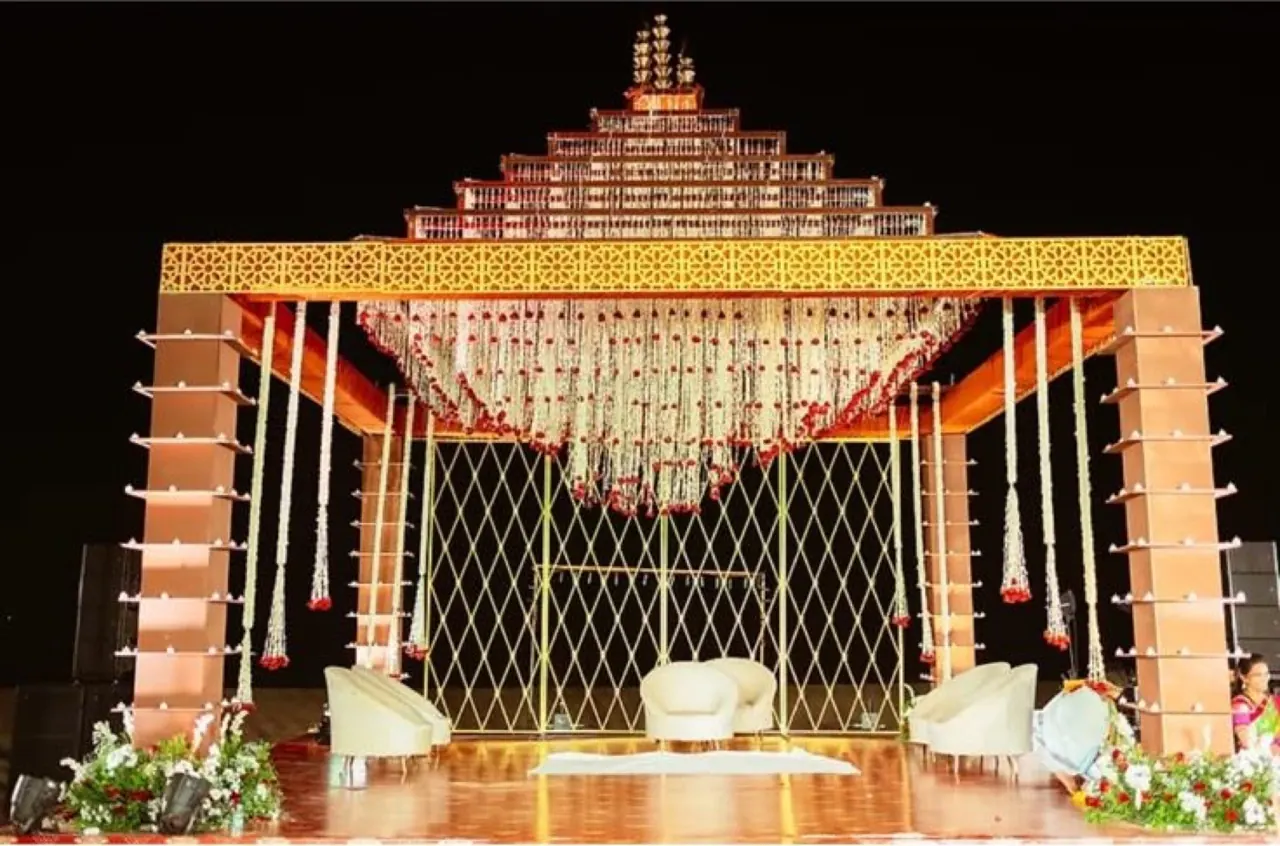
The St. Regis Goa Resort, Mobor. A three-day wedding for 250 guests with two ceremonies in one weekend. The tiered gopuram mandap stood on open sand and was designed to read twice over: once against the sunset for the South Indian ceremony, once fully lit against the night sky. The entrance to it ran as a corridor of jasmine garlands, and the detailing was brass lamps dressed with tuberose and rose. The second ceremony on the same weekend was a pastel floral arch under the palms with a mirrored aisle.
The haldi on the same weekend. A blue-and-white azulejo backdrop, taken from the Portuguese tilework Goa is full of, with a yellow Vespa parked under a tiled arch, a painted giraffe on the walkway and blue velvet lounge seating. It is the clearest example of the argument on this page: none of it exists in a rental catalogue, because it was drawn for one wedding.
The Leela Goa. Six hundred guests in February. The sangeet build was drawn to scale and made for the site, and the ceremony on the sand was built low and weighted against the sea breeze rather than styled tall and hoped for.
What the Goa coast does to decor
Every inland decor habit fails somewhere on a Goa beach, and the failures are predictable enough to design around. Sea wind is constant and strengthens through the afternoon, so anything tall on sand is weighted below the sand line. Coastal-zone rules want beach builds temporary and weighted rather than dug in or concreted, which happens to be the right engineering anyway.
Salt air is the quiet editor. It takes the shine off thin plating within hours, which is why brass earns its place on a coastal build: it holds up in coastal light and it has a long Goan and South Indian ceremonial history behind it. Painted and sealed timber outlasts raw finishes. Fabric is engineered or left off the windward face rather than hung and hoped for.
Humidity is the third one. It softens paper and untreated fabric, so signage, menus and anything printed do their living indoors or get a material that does not care. The flowers that do best are the ones already at home in this weather: jasmine strung by the metre, marigold, tuberose. Delicate stems are not banned, they are placed where the design shelters them. The full workshop notes are in decor that survives sea air.
Light is the one element the coast cannot touch. Wind cannot shred it and humidity cannot soften it, and it gives an outdoor build a second life after sunset. Cabling on sand is production work rather than styling work, which is why the lighting plan belongs in the drawings and not on the install day.
How decor is priced in Goa
Decor is the widest honest range in a Goa wedding budget, because it is the one line you design rather than buy at a published rate. The venue's per-plate figures are printed on the cost guide because the venue publishes them. Nobody publishes a decor rate, and any decorator quoting a per-head number before seeing a drawing is quoting a catalogue.
Here is how it is structured with us. The design sits inside our flat planning and design fee, which is ₹5–25 lakh+ set by scope after the first call and is published in the open. The build is separate and quoted line by line once the drawings are done: materials, fabrication, crew, install and strike, each as its own line. You see the cost of the set before it is made.
What we will not do is print a decor figure here. Our venue book leaves a field blank rather than estimating it, and the same rule applies to a build we have not costed. What we can tell you is the shape of the whole: on the budget table in the cost guide, the design-and-build cell is the one that says ask, on purpose.
Two things move a decor quote more than taste does. The number of set-ups: a haldi, a sangeet and a ceremony are three builds, not one design used three times. And where it stands: sand needs weighting, generators and a crew that can work on an unpowered site, so the same design costs more on a beach than on a lawn with a plug socket.
Fee and budget figures above ≈ USD / GBP / AED at ₹1 = $0.0115 / £0.0089 / AED 0.042 (indicative, Aug 2026). We quote in rupees; your bank sets the day's rate.
Ask for a call in your time zoneA decorator, a coordinator and a studio are three different purchases
A decorator supplies and installs, usually from stock. A coordinator books the decorator and manages the schedule, which is a real service and some of them are very good at it. A studio draws the wedding and then makes it. All three get called wedding decorators in Goa, and the quotes look similar until you ask what is actually being built.
Two questions sort it quickly. Ask to see drawings rather than photographs, because a studio that designs has plans and elevations of its own work while a company that books has pictures of somebody else's. Then ask whether the mandap is built for you or hired in. More of these are in how to choose a wedding planner in Goa.
Decor changes with the building it stands in
On sand. Wind is the structural brief and the tide has a vote on where the ceremony line can even go. Builds run lower and heavier than they look, and the palette leans to materials that do not mind salt. The permissions for what may stand on a beach are set village by village: see the beach permissions guide, and the priced list of beachfront venues.
In a Portuguese house. The heritage properties in our book come with courtyards, verandas and two-century-old walls that are already doing most of the design work. The job here is restraint and lighting rather than volume, and the constraint is usually access: what can be carried through an old doorway decides what can be built inside it.
At a five-star resort. Lawns, ballrooms and a beach in front, with power and a service road, which is the easiest ground to build ambitiously on. The constraints are the venue's own: what may be pinned to a ceiling, when the crew may load in, and the outdoor sound cut-off at 10pm that ends the open-air half of the evening across Goa.
Where our decor work sits on the rest of this site
How the studio works is on the studio page. Project records at named venues, with guest counts, are in the wedding archive. What the whole wedding costs, with per-plate figures venue by venue, is on the cost guide, and the way a package is assembled around the build is on the packages guide.
What couples ask about decor
How much does wedding decor cost in Goa?
It is quoted per wedding, and we do not publish a rate we have not costed for a real design. The figure we can give you is our planning and design fee: a flat ₹5–25 lakh+, set by scope. The build itself is quoted line by line after the design is drawn, because the honest number depends on what is being made rather than on a per-head rate.
What is the difference between a wedding decorator and a wedding designer in Goa?
A decorator supplies and installs. Most of what circulates in Goa is rental stock, styled on site, which is why the same mandap and the same backdrop turn up at several weddings in a season. A designer draws your wedding first, to scale, and then has it made. The Goa Wedding Co. works the second way: the wedding is drawn first and then built to the drawing.
Do you rent your decor or build it?
The design is built, not rented. Each set is made once, for the wedding it was designed for, so two weddings at the same venue need not look alike. Ask for the build list in the quote, so you can see what is made for you and what is hired in, such as chairs or a generator.
What decor survives the sea air in Goa?
Brass rather than cheap metallics, because salt air dulls thin plating fast and brass reads richer in coastal light. Painted and sealed timber over raw finishes. Flowers chosen for stems that hold to evening, which is why jasmine, marigold and tuberose anchor so much coastal decor here. Anything tall on sand is weighted below the sand line, and paper goods do their living indoors.
Can you decorate for a monsoon or shoulder-season wedding?
Yes, and it changes the brief rather than shrinking it. Between June and September the design is built for covered ground from the start, with the structure engineered for the rain instead of a fabric set moved indoors on the morning. Humidity softens paper and untreated fabric, so the material list moves toward sealed timber, metal and light. Our rain-plan guide covers how the fallback is decided.
How far in advance should decor be designed for a Goa wedding?
Drawings start as soon as the venue is signed, which for a November or December wedding is usually ten to twelve months out. The design has to be frozen well before the build, and fabrication for a full three-day wedding runs to weeks rather than days. A late brief does not usually cost more; it costs range, because what can be made in the time left is a shorter list.
Do you work at venues you have not worked at before?
Regularly. The venue book on this site runs to 99 properties and no studio has built at all of them. What matters is that the studio is in Goa, so a new venue is a site visit and a set of measurements rather than a phone call, and the design is drawn against the real ground before anything is cut.
Do you take a commission on flowers or vendors?
No. Our fee is flat and set by scope, so nothing we specify pays us more. The build is quoted line by line, and anything contracted outside it is contracted by you on quotes you have seen. A planner paid a percentage earns more every time the decor line goes up, which is the wrong incentive to put in the room.
Ask us about the design for your wedding
We will come back with what it holds, what it costs on your dates, and whether it is the right room for the wedding you are describing.
- A call from the Goa team within one working day.
- A written scope and a fee band for your wedding, in your inbox.
- A video walkthrough of the shortlist if you are abroad.
For the photography handover, Élan Films’ light, sound and timeline brief sets out questions to agree with your own photo team.